總網頁瀏覽量

2009年4月5日 星期日

Irish Art Encyclopedia.

PROBLEMS OF DEFINITION
Language can describe things or associate one predefined term with another, but it has great difficulty defining artistic concepts. No wonder postmodernist artists have been able to extend the ambit of "art" to include dead sharks. I mean, no one really knows the limits of artistic activity.

DEFINITION OF BEAUTY
A combination of qualities that delights the aesthetic senses - that is to say, the senses concerned with the appreciation of beauty. [Concise Oxford Dictionary]

DEFINITION OF SCULPTURE
The art of making three-dimensional representative or abstract forms, especially by carving stone or wood, or by casting metal or plaster. [Concise Oxford Dictionary]

DEFINITION OF ARTIST
A person who creates paintings or drawings as a profession or hobby or who practises or performs any of the creative arts. [Concise Oxford Dictionary]

DEFINITION OF CRAFT
An activity involving skill in making things by hand. [Concise Oxford Dictionary]
[Sounds like it includes art!]

DICTIONARY DEFINITIONS OF ART
Most dictionaries define "art" by giving it a variety of meanings:
(eg) "the expression or application of creative skill and imagination, often through a visual medium like painting, or 3-D media like sculpture." Or (eg) "Types of creative activity like drawing, music, literature and dance." Or "Subjects of study mainly concerned with human culture rather than with scientific or technical subjects."

MEANING OF AESTHETICS
Aesthetics (or esthetics) - a term derived from the Greek word " aisthesis" meaning "perception" -is the branch of philosophy that is devoted to the study of art and beauty. It seeks to provide answers to questions such as: What is art? What is the value of painting or sculpture? How to assess a work of art? What is the purpose of art? and so on.

What is Art?

There is no universally accepted definition of art. Although commonly used to describe something of beauty, or a skill which produces an aesthetic result, there is no clear line in principle between (say) a unique piece of handmade sculpture, and a mass-produced but visually attractive item. We might say that art requires thought - some kind of creative impulse - but this raises more questions: for example, how much thought is required? If someone flings paint at a canvas, hoping by this action to create a work of art, does the result automatically constitute art?

Even the notion of 'beauty' raises obvious questions. If I think my kid sister's unmade bed constitutes something 'beautiful', or aesthetically pleasing, does that make it art? If not, does its status change if a million people happen to agree with me, but my kid sister thinks it is just a pile of clothes?


Art: Multiplicity of Forms, Types and Genres
Before trying to define art, the first thing to be aware of, is its huge scope. Art is a global activity which encompasses a host of disciplines, as evidenced by the range of words and phrases which have been invented to describe its various forms. Examples of such phraseology include: "Fine Arts", "Liberal Arts", "Visual Arts", "Decorative Arts", "Applied Arts", "Design", "Crafts", "Performing Arts", and so on. Drilling down, many specific categories are classified according to the materials used, such as: drawing, painting, sculpture (inc. ceramic sculpture), "glass art", "metal art", "illuminated gospel manuscripts", "aerosol art", "fine art photography", "animation", and so on. Sub-categories include: painting in oils, watercolours, acrylics; sculpture in bronze, stone, wood, porcelain; to name but a tiny few. Other sub-branches include different genre categories, like: narrative, portrait, genre-works, landscape, still life. Art: Multiplicity of Forms, Types and Genres Before trying to define art, the first thing to be aware of, is its huge scope. Art is a global activity which encompasses a host of disciplines, as evidenced by the range of words and phrases which have been invented to describe its various forms. Examples of such phraseology include: "Fine Arts", "Liberal Arts", "Visual Arts", "Decorative Arts", "Applied Arts", "Design", "Crafts", "Performing Arts", and so on. Drilling down, many specific categories are classified according to the materials used, such as: drawing, painting, sculpture (inc. ceramic sculpture), "glass art", "metal art", "illuminated gospel manuscripts", "aerosol art", "fine art photography", "animation", and so on. Sub-categories include: painting in oils, watercolours, acrylics; sculpture in bronze, stone, wood, porcelain; to name but a tiny few. Other sub-branches include different genre categories, like: narrative, portrait, genre-works, landscape, still life.

In addition, entirely new forms of art have emerged during the 20th century, such as: assemblage, collage, earthworks, installation, graffiti, and video, as well as the broad conceptualist movement which challenges the essential value of an objective "work of art".

Definition of Art is Limited by Era and Culture

Another thing to be aware of, is the fact that art reflects and belongs to the period and culture from which it is spawned.

After all, how can we compare prehistoric murals (eg. stone age cave painting) or tribal art, or native Oceanic art, or primitive African art, with Michelangelo's 16th century Old Testament frescoes on the walls and ceiling of the Sistine Chapel? Political events are the most obvious era-factors that influence art: for example, art styles like Expressionism, Dada, Surrealism and postmodernism were products of political uncertainty and upheavals.

Cultural differences also act as natural borders. After all, Western draughtsmanship is light years away from Chinese calligraphy; and what Western artform compares with Japanese origami paper art? Religion is a major cultural variable that alters the shape of the artistic envelope. The Baroque style was strongly influenced by the Catholic Counter-Reformation, while Islam (like Orthodox Christianity), forbids certain types of artistic iconography.

In other words, whatever definition of art we arrive at, it is bound to be limited to our era and culture.

Conclusion

As you can see from the above, the world of art is a highly complex entity, not only in terms of its multiplicity of forms and types, but also in terms of its historical and cultural roots. Therefore a simple definition, or even a broad consensus as to what can be labelled art, is likely to prove highly elusive.

History of the Definition of Art

For a guide to movements and periods, see also: History of Art.

Classical Meaning of Art

The original classical definition - derived from the Latin word "ars" (meaning "skill" or "craft") - is a useful starting point. This broad approach leads to art being defined as: "the product of a body of knowledge, most often using a set of skills." Thus Renaissance painters and sculptors were viewed merely as highly skilled artisans (interior-decorators?), capable of creating representational pictures or 3-D works. No wonder Leonardo Da Vinci and Michelangelo went to such efforts to elevate the status of artists (and by implication art itself) onto a more intellectual plane.

Post-Renaissance Meaning of Art

The emergence of the great European academies of art reflected the gradual upgrading of the subject. New and enlightened branches of philosophy also contributed to this change of image. By the mid-18th century, the mere demonstration of technical skills was insufficient to qualify as art - it now needed an "aesthetic" component - it had to be seen as something "beautiful."

At the same time, the concept of "utilitarianism" (functionality or usefulness) was used to distinguish the more noble "fine arts" (art for art's sake), like painting and sculpture, from the lesser forms of "applied art", such as crafts and commercial design work, and the ornamental "decorative arts", like textile design and interior design.

Thus, by the end of the 19th century, art was separated into at least two broad categories: namely, fine art and the rest - a situation that reflected the cultural snobbery and moral standards of the European establishment. Furthermore, despite some erosion of faith in the aesthetic standards of Renaissance ideology - which remained a powerful influence throughout the world of fine art - even painting and sculpture had to conform to certain aesthetic rules in order to be considered "true art".

Meaning of Art During the Early 20th Century

Then came Cubism (1907-14), which rocked the fine arts establishment to its foundations. Not simply because Picasso introduced a non-naturalistic branch of painting and sculpture, but because it shattered the monotheistic Renaissance approach to how art related to the world around it. Thus, Cubism's main contribution was to act as a sort of catalyst for a host of new movements which greatly expanded the theory and practice of art, such as: Suprematism, Constructivism, Dada, Neo-Plasticism, Surrealism and Conceptualism, as well as various realist styles, such as Social and Socialist Realism. In practice, this proliferation of new styles and artistic techniques led to a new broadening of the meaning and definition of art. In its escape from its "Renaissance straitjacket", and all the associated rules concerning "objectivity" (eg. on perspective, useable materials, content, composition, and so on), fine art now boasted a significant element of "subjectivity". Artists suddenly found themselves with far greater freedom to create paintings and sculpture according to their own subjective values. In fact, one might say that from this point "art" started to become "indefinable".

The decorative and applied arts underwent a similar transformation due to the availability of a vastly increased range of commercial products. However, the resultant increase in the number of associated design and crafts disciplines did not have any significant impact on the definition and meaning of art as a whole.

Meaning of Art Post-World War II

The cataclysm of WWII led to the demise of Paris as the capital of world art, and its replacement by New York. This new American orientation encouraged art to become more of a commercial product, and loosen its connection with existing traditions of aestheticism - a trend furthered by the emergence of Abstract Expressionism, Pop-Art, and the activities of the new breed of celebrity artists like Andy Warhol. All of a sudden, even the most mundane items and concepts became elevated to the status of "art". Under the influence of this populist approach, conceptualists introduced new artforms, like assemblage, installation, video and performance. In due course, graffiti added its own mark, as did numerous styles of reinterpretation, like Neo-Dada, Neo-Expressionism, and Neo-Pop, to name but three. Schools and colleges of art throughout the world dutifully preached the new polytheism, adding further fuel to the bonfire of Renaissance traditions.

Postmodernism and the Meaning of Art

The redefinition of art during the last three decades of the 20th century has been lent added intellectual weight by theorists of the postmodernist movement. According to the postmoderns, the focus has shifted from artistic skill to the "meaning" of the work produced. In addition, "how" a work is "experienced" by spectators has become a critical component in its aesthetic value. The phenomenal success of contemporary artists like Damien Hirst, as well as Gilbert and George, is clear evidence in support of this view.


A Working Definition of Art (2009)

In light of this historical development in the meaning of "art", one can perhaps make a crude attempt at a "working" definition of the subject, along the following lines:

Art is created when an artist creates a beautiful object, or produces a stimulating experience that is considered by his audience to have artistic merit.

This is simply a "working" definition: broad enough to encompass most forms of contemporary art, but narrow enough to exclude "events" whose "artistic" content falls below accepted levels. In addition, please note that the word "artist" is included to allow for the context of the work; the word "beautiful" is included to reflect the need for some "aesthetic" value; while the phrase "that is considered by his audience to have artistic merit" is included to reflect the need for some basic acceptance of the artist's efforts.

Theory and Philosophy of Art: Discussion Issues

Q. If We Appreciate Its Positive Impact, Do We Need to Define Art?

For centuries, if not millennia, people have been emotionally affected - sometimes overwhelmed - by works of art: from Greek Sculpture, to Byzantine architecture, the stunning creativity of Renaissance and Baroque Old Masters like Donatello, Raphael and Rembrandt, and famous artists of the modern era, like Van Gogh, Picasso and Auguste Rodin. Poetry, ballet and films can be equally uplifting. So while we may not be able to explain precisely what art is, we cannot deny the impact it has on our lives - one reason why public art is worth supporting.

Q. How Does a Definition of the Meaning of Art Help Us?

The very essence of creativity means it cannot be defined and pigeon-holed. Any attempt at doing so, will quickly become out-of-date and thus pointless, even counter-productive. What happens, for instance, if an artist produces something that by popular consensus is "art", but isn't accepted as such by the arts establishment? It's worth remembering that we still can't define a "table" or an "elephant", but it doesn't cause us much difficulty!

Q. Is Art Simply a Reflection of Our Personal Values?

It's fair to say that someone educated in the values of Renaissance art, and who therefore has a reasonable understanding of traditional painting, is less likely to regard postmodernist installations as art, than a person without such an understanding. Similarly, a person who loves TV and thinks museums are generally rather boring and unexciting places, is more likely to be impressed with contemporary video art than someone else who is comfortable with traditional museum exhibitions. Because of this, one might say that a person's attitude to art says more about his or her personal values, than the art itself.

Q. Who Has the Right to Define Art?

Since no consensus as to the meaning of art is likely to emerge anytime soon, which set of "experts" should be allowed to take charge: Artists, sociologists, historians, lawyers, philosophers, archeologists, anthropologists, or psychologists? After all, the world is full of so-called "experts" - structuralists, proceduralists, functionalists, as well as the usual crop of political theorists like Marxists and so on - who can't agree on what counts as art. So who do we give the job to?

How is Art Classified?

Traditional and contemporary art encompasses activities as diverse as:

Architecture, music, opera, theatre, dance, painting, sculpture, illustration, drawing, cartoons, printmaking, ceramics, stained glass, photography, installation, video, film and cinematography, to name but a few.

All these activities are commonly referred to as "the Arts" and are commonly. classified into several overlapping categories, such as: fine, visual, plastic, decorative, applied, and performing.

Disagreement persists as to the precise composition of these categories, but here is a generally accepted classification.

1. Fine Arts

This category includes those artworks that are created primarily for aesthetic reasons ('art for art's sake') rather than for commercial or functional use. Designed for its uplifting, life-enhancing qualities, fine art typically denotes the traditional, Western European 'high arts', such as:

• Drawing
Using charcoal, chalk, crayon, pastel or with pencil or pen and ink.

• Painting
Using oils, watercolour, gouache, acrylics, ink and wash, or the more old-fashioned tempera or encaustic paints.

• Printmaking
Using simple methods like woodcuts or stencils, the more demanding techniques of engraving, etching and lithography, or the more modern forms like screen-printing or foil imaging.

• Sculpture
In bronze, stone or wood, or clay.

Another type of Western fine art, which originated in China, is calligraphy: the highly complex form of stylized writing.

The Evolution of Fine Arts

After primitive forms of cave painting, figurine sculptures and other types of ancient art, there occured the golden era of Greek art and other schools of Classical Antiquity. The sacking of Rome (c.400-450) introduced the dead period of the Dark Ages (c.450-1000), after which the history of art in the West is studded with a wide variety of artistic 'styles' or 'movements' - such as: Gothic (c.1100-1300), Renaissance (c.1300-1600), Baroque (17th century), Neo-Classicism (18th century), Romanticism (18th-19th century), Realism and Impressionism (19th century), Cubism, Expressionism, Surrealism, Abstract Expressionism and Pop-Art (20th century).

For a brief review of modernism (c.1860-1965), see Modern art movements; for a guide to postmodernism, (c.1965-present) see our list of the main Contemporary art movements.

The Tradition

Fine art was the traditional type of Academic art taught at the great schools, such as the the Accademia dell'Arte del Disegno in Florence, the Accademia di San Luca in Rome, the Académie des Beaux-Arts in Paris, and the Royal Academy in London. One of the key legacies of the academies was their ranking of the painting genres, which classified all works into 5 types: history, portrait, genre-scenes, landscape or still life.

2. Visual Arts

This category includes all the fine arts as well as new media and contemporary forms of expression such as Assemblage, Collage, Conceptual, Installation and Performance art, as well as film-based forms like Photography, Video Art and Animation, or any combination thereof. Another type of visual art, sometimes created on a monumental scale is the new environmental art. Other, personal forms include Face Painting and Body Painting.

3. Plastic Arts

This category typically denotes three-dimensional works employing materials that can be moulded, shaped or manipulated (plasticized) in some way: such as, clay, plaster, stone, metals, wood (sculpture), paper (origami) and so on.

4. Decorative Arts

This category traditionally denotes functional but ornamental art forms, such as works in glass, clay, wood, metal, or fabric. This includes ceramics, as exemplified by Chinese Pottery and Greek Pottery, furniture, furnishings, stained glass and interior design. Noted styles of decorative art include: Rococo, Pre-Raphaelite, Second Empire, Edwardian, Art Deco, Art Nouveau, Japonism and Retro.

5. Performance Arts

This type refers to public performance events. Traditional varieties include, theatre, opera, music, and ballet. Contemporary performance art also includes any activity in which the artist's physical presence acts as the medium. Thus it encompasses, mime, face or body painting, and the like. A hyper-modern type of performance art is known as Happenings.

6. Applied Arts

This category encompasses all activities involving the application of aesthetic designs to everyday functional objects. While fine art provides intellectual stimulation to the viewer, applied art creates utilitarian items (a cup, a couch or sofa, a clock, a chair or table) using aesthetic principles in their design. This wide area includes architecture, photography, industrial design, graphic design, fashion design, interior design, as well as all decorative arts. Noted styles include, Bauhaus, as well as Art Nouveau, and Art Deco.

The 'Arts Versus Crafts' Debate

According to the traditional theory of art, there is a basic difference between an 'art' and a 'craft'. Put simply, although both activities involve creative skills, the former involves a higher degree of intellectual involvement. Under this analysis, a basket-weaver (say) would be considered a craftsperson, while a bag-designer would be considered an artist. In this rather artificial distinction between arts and crafts, functionality is a key factor. Thus, a jeweller who designs and makes non-functional items like rings or necklaces would be considered an artist, while a watchmaker would be a craftsperson; someone who makes glass might be a craftsman, but a person who makes stained glass is an artist. The idea is that artists are somehow superior because they 'create' things of beauty, while craftsmen perform repetitive or purely functional actions. There may be some truth behind this theory, but many types of craftsmanship seem no different to genuine art. An example perhaps, is a cartoonist-animator, exployed to draw thousands of similar pictures of a cartoon character like 'Charlie Brown'. True, his 'art' is purely functional and highly commercial, but no one could deny he was an artist.

The Impact of the Renaissance on the Western Concept of Art

In general, until the early Renaissance of the 15th century, all artists were considered tradesmen/craftsmen. Even the greatest painters like Giotto, Botticelli, Leonardo da Vinci and Raphael were seen as no more than skilled workers, while master sculptors like Donatello were seen as mere specialist stone-cutters and bronze metalworkers. Indeed, it was Leonardo's and Michelangelo's stated aim to raise the level of the artist to that of a profession - an ambition which was duly realized in 1561 with the founding of the first Art Academy in Florence, which was set up to train people in the profession of drawing (disegno).

However, although Renaissance artists succeeded in raising their craft to the level of a profession, they defined art as an essentially intellectual activity. This fixed Renaissance idea of art being primarily an intellectual discipline was passed on down the centuries and still influences present day conceptions of the meaning of art. Despite some modifications, as exemplified by changes in art school curricula, fine art still maintains its notional superiority over crafts such as applied and decorative arts.

Questions About Art

We may not be able to define art, but we can explore it further by asking questions about its nature and scope. Here are some of the key questions along with a short commentary.

• What's the Point of Art?
• How to Distinguish Good Art from Bad Art?
• Why Do Art Experts Make Everything Sound So Complicated?
• Examples of Meaningless Art Reviews: Why use this Jargon?
• What's the Meaning of Abstract Art? It Looks Weird!
• Should Art be Subsidized?

What's the Point of Art?

Sceptics say that art is a waste of time. Even the famous poet WH Auden confessed that no poem saved a single person from the Nazi gas-chambers. And while this may sound a rather meaningless statement, it highlights the notion that art has a limited use in our daily life, except in the case of attractive-looking buildings, teapots, cars or clothes.

There are two broad answers: first, applied art is a major branch of art which cannot easily be separated from fine art, because the root of all design (which is the foundation of applied art) is fine art. Second, ever since Homo Sapiens developed the facility of contemplation, he has expressed his thoughts in pictorial form. At the same time, he has continued to appreciate beauty - whether in the form of human faces or bodies, sunsets, animal-skin colours, cathedrals or sculpture. In a nutshell, to create and to appreciate art is to be human. That's the point.

How to Distinguish Good Art from Bad Art?

Not being able to define art doesn't mean that all artworks are good. Trouble is, who decides where good art ends and bad begins?

This popular question may stem from our natural desire to avoid being hoodwinked by snake-oil salesmen dressed up as 'artists', but whatever its origin it is not a particularly important issue. In practice, professional artists need public acceptance. So while temporary art-fashions may occasionally promote works of apparently dubious value, the general public (as well as the artistic community) is unlikely to stand by and allow bad art to become commonplace. See also the Most Expensive Irish Paintings.

Why Do Art Experts Make Everything Sound So Complicated?

An example of this might be the jargon-infested articles commonly encountered in arts magazines, where nobody seems to use plain language anymore. Other culprits include exhibition catalogues and art books.

The writers of this stuff might say that such jargon is no more than necessary shorthand, and that it is mostly written for other 'experts'. But is this really true? For example, it is almost impossible to find a book with a simple explanation of Cubism. So how does a young student get to understand why Picasso and Braque's revolutionery movement is so important? The same could be said about dozens of things in the world of art. And some abstract art sounds so complicated that we almost need a PhD in order to properly 'comprehend' it. (See next question for examples)

Examples of Meaningless Art Reviews: Why use this Jargon?

Modern reviewers, critics and artists frequently resort to meaningless nonsense when trying to describe a piece of "art". Here are some examples which have been kept anonymous to spare their authors' embarassment. All were taken from press releases or websites of 'respectable' bodies:

How Not to Write an Art Review!

"The title sums up the intent of the exhibition: to locate painting in the realm of possibility and to consider the necessity of interrogation and experiment if painting is to continue to evolve towards a place of limitless potential."

"...is the first exhibition to delve into such diverse themes as play and longing, the intensity of personal space, the obsessive organic, abstract colour, inner construction, architectural space and time and transcendence."

"[name of artist] made a series of impeccable works interrogating the basic constituents of the materials of painting, titled after Alberti's treatise Della Pittura . Each piece meticulously pursued a related though distinct line of enquiry with great ingenuity."

"Poststructuralists beginning with Jacques Derrida, who coined the term, argued that the existence of deconstructions implied that there was no intrinsic essence to a text, merely the contrast of difference. This is analogous to the idea that the difference in perception between black and white is the context."

"[name of artist]'s work is about possibilities; an attempted manifestation of the importance of freedom. Examining the multi meanings of seemingly ordinary objects, he engages in the transcendence of function"

What's the Meaning of Abstract Art? It Looks Weird!

Up until the late nineteenth century, most painting and sculpture adhered to traditional principles. Typically, it was representational and naturalistic. Then Impressionism changed everything by introducing non-natural colour schemes: a process continued by the Fauves and the Expressionists. Then Cubism rejected the notion of depth or perspective in painting, and opened the door to more abstract art, including movements like Futurism, De Stijl, Dada, Constructivism, Surrealism, Neo-Plasticism, Abstract Expressionism, and Op-Art, to name but a few. In Ireland, painters like Mary Swanzy, Mainie Jellet and Evie Hone were early pioneers of such modern art.

Because abstract art has few if any naturalistic elements, it is not as instantly appreciable as (say) a classical portrait or landscape. And if you prefer a work of art to portray recognizable people and surroundings, then abstract art is not likely to be for you. But, let's be honest, is this so different from recoiling at the idea of wearing a particular colour or style of clothing? Different people like different things, and this applies to art as much as to jobs, cars, houses, furniture, vacations, and everything else you can think of.

Abstract, or non-naturalistic paintings tend to contain an implicit message or follow a particular theory of art. This can make them less likeable and less beautiful to some people, but it doesn't mean they can't be outstanding works of art.

Should Art be Subsidized?

It is extremely hard for most full-time artists to earn a living from (say) their painting or sculpture. To this, the sceptics retort: "well if no one wants to buy their stuff, why should the tax-payer pay for it?"

One should not dismiss this concern too lightly. After all, these sceptics aren't saying that artists shouldn't practise their art, simply that an artist should seek private sponsorship.

One answer to the question is this. First, in reality, most art colleges train students in a range of highly commercial activities, notably in the area of applied art and design. So for these individuals there is no question of subsidy. Moreover, those students who do opt for a full-time career as a painter or sculptor, are choosing a very arduous and materially unrewarding type of life. Not least because sponsorship (in the form of public commissions, bursaries, artist-in-residences, and other grants) is actually very meagre. The level of public subsidy of the arts in Western countries remains pretty low, compared to other equivalent areas. So even here, the amount of public money being spent on works of art is not especially significant.

Nonetheless, public money is being spent, and here is a reason for it. Beauty, whether in the form of an attractive-looking car, a well-designed public building or square, a colourful dress, or an inspiring sculpture, is one of the few phenomena that lifts the spirits and reminds us there is more to life than the price of eggs. But without art, this range of aesthetic experiences will gradually dwindle, as beauty becomes progressively downgraded as a worthwhile goal. Literature (if not history) is full of examples of this type of society, where functionality is everything and citizens wear the same drab clothing, dwell in the same drab apartments, and lead the same drab lives.

Online Collections of Painting and Sculpture

There are tons of paintings and sculptures online. (This website alone displays thousands of different images.) Search for the large art museums such as the Uffizi Gallery (Florence), the Louvre (Paris), the Prado Museum (Madrid), the Pinakothek Gallery (Munich), the Tate Gallery (Britain, Modern, Liverpool and St Ives), the National Gallery (London), the Gemaldegalerie (Berlin), Hermitage Museum (St Petersburg), the Metropolitan and Guggenheim Museums (New York) and the National Gallery (Washington DC), to name but a few.

Unfortunately, Irish art galleries (with the notable exception of the Crawford Gallery in Cork) are not as visible on the Internet as they should be, but there are plenty of private art galleries in Ireland that have wonderful displays that are available to browse.

Wikipedia

From Wikipedia, the free encyclopedia

Jump to: navigation, search
Pompeii, House VII, 2, 6: Paquius Proculus and his wife. National Archaeological Museum of Naples in Naples, Italy, 1st century fresco.
Jean-Auguste-Dominique Ingres, Le Bain turc (The Turkish baths), 1862
Vincent van Gogh, The Café Terrace on the Place du Forum, Arles, at Night, September 1888.

Art is the process or product of deliberately arranging elements in a way that appeals to the senses or emotions. It encompasses a diverse range of human activities, creations, and modes of expression, including music and literature. The meaning of art is explored in a branch of philosophy known as Aesthetics.

The definition and evaluation of art has become especially problematic since the early 20th century. Richard Wollheim distinguishes three approaches: the Realist, whereby aesthetic quality is an absolute value independent of any human view; the Objectivist, whereby it is also an absolute value, but is dependent on general human experience; and the Relativist position, whereby it is not an absolute value, but depends on, and varies with, the human experience of different humans.[1] An object may be characterized by the intentions, or lack thereof, of its creator, regardless of its apparent purpose. A cup, which ostensibly can be used as a container, may be considered art if intended solely as an ornament, while a painting may be deemed craft if mass-produced.

Traditionally, the term art was used to refer to any skill or mastery. This conception changed during the Romantic period, when art came to be seen as "a special faculty of the human mind to be classified with religion and science".[2] Generally, art is made with the intention of stimulating thoughts and emotions.

The nature of art has been described by Richard Wollheim as "one of the most elusive of the traditional problems of human culture".[3] It has been defined as a vehicle for the expression or communication of emotions and ideas, a means for exploring and appreciating formal elements for their own sake, and as mimesis or representation.[4] Leo Tolstoy identified art as a use of indirect means to communicate from one person to another.[4] Benedetto Croce and R.G. Collingwood advanced the idealist view that art expresses emotions, and that the work of art therefore essentially exists in the mind of the creator.[5][6] The theory of art as form has its roots in the philosophy of Immanuel Kant, and was developed in the early twentieth century by Roger Fry and Clive Bell.[4] Art as mimesis or representation has deep roots in the philosophy of Aristotle.[4]


Definition of the term

The most common usage of the word "art," which rose to prominence after 1750, is understood to denote skill used to produce an aesthetic result.[7] Britannica Online defines it as "the use of skill and imagination in the creation of aesthetic objects, environments, or experiences that can be shared with others."[8] By any of these definitions of the word, artistic works have existed for almost as long as humankind: from early pre-historic art to contemporary art; however, some theories restrict the concept to modern Western societies.[9] Much has been written about the concept of "art".[10] Where Adorno said in 1970 "It is now taken for granted that nothing which concerns art can be taken for granted any more[...],"[11],[12] The first and broadest sense of art is the one that has remained closest to the older Latin meaning, which roughly translates to "skill" or "craft," and also from an Indo-European root meaning "arrangement" or "to arrange". In this sense, art is whatever is described as having undergone a deliberate process of arrangement by an agent. A few examples where this meaning proves very broad include artifact, artificial, artifice, artillery, medical arts, and military arts. However, there are many other colloquial uses of the word, all with some relation to its etymology.

The second and more recent sense of the word art is as an abbreviation for creative art or fine art. Fine art means that a skill is being used to express the artist’s creativity, or to engage the audience’s aesthetic sensibilities, or to draw the audience towards consideration of the finer things. Often, if the skill is being used in a common or practical way, people will consider it a craft instead of art. Likewise, if the skill is being used in a commercial or industrial way, it will be considered Commercial art instead of fine art. On the other hand, crafts and design are sometimes considered applied art. Some art followers have argued that the difference between fine art and applied art has more to do with value judgments made about the art than any clear definitional difference.[13] However, even fine art often has goals beyond pure creativity and self-expression. The purpose of works of art may be to communicate ideas, such as in politically-, spiritually-, or philosophically-motivated art; to create a sense of beauty (see aesthetics); to explore the nature of perception; for pleasure; or to generate strong emotions. The purpose may also be seemingly nonexistent.

Painting by Song Dynasty artist Ma Lin, c. 1250. 24,8 × 25,2 cm.

Art can describe several things: a study of creative skill, a process of using the creative skill, a product of the creative skill, or the audience’s experience with the creative skill. The creative arts (art as discipline) are a collection of disciplines (arts) that produce artworks (art as objects) that are compelled by a personal drive (art as activity) and echo or reflect a message, mood, or symbolism for the viewer to interpret (art as experience). Artworks can be defined by purposeful, creative interpretations of limitless concepts or ideas in order to communicate something to another person. Artworks can be explicitly made for this purpose or interpreted based on images or objects. Art is something that stimulates an individual's thoughts, emotions, beliefs, or ideas through the senses. It is also an expression of an idea and it can take many different forms and serve many different purposes. Although the application of scientific theories to derive a new scientific theory involves skill and results in the "creation" of something new, this represents science only and is not categorized as art.

History

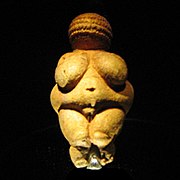
Venus of Willendorf.

Art predates history; sculptures, cave paintings, rock paintings, and petroglyphs from the Upper Paleolithic starting roughly 40,000 years ago have been found, but the precise meaning of such art is often disputed because so little is known about the cultures that produced them. The oldest art objects in the world: a series of tiny, drilled snail shells about 75,000yrs old, were discovered in a South African cave.[14]

The great traditions in art have a foundation in the art of one of the great ancient civilizations: Ancient Egypt, Mesopotamia, Persia, India, China, Ancient Greece, Rome, or Arabia (ancient Yemen and Oman). Each of these centers of early civilization developed a unique and characteristic style in their art. Because of the size and duration these civilizations, more of their art works have survived and more of their influence has been transmitted to other cultures and later times. They have also provided the first records of how artists worked. For example, this period of Greek art saw a veneration of the human physical form and the development of equivalent skills to show musculature, poise, beauty and anatomically correct proportions

In Byzantine and Gothic art of the Western Middle Ages, art focused on the expression of Biblical and not material truths, and emphasized methods which would show the higher unseen glory of a heavenly world, such as the use of gold in the background of paintings, or glass in mosaics or windows, which also presented figures in idealized, patterned (flat) forms.

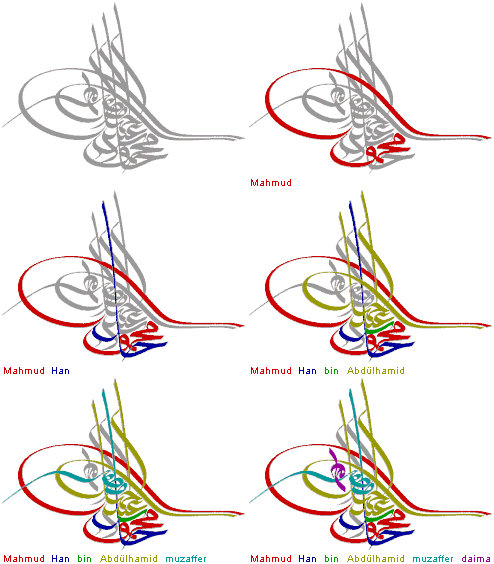
The stylized signature of Sultan Mahmud II of the Ottoman Empire was written in Arabic calligraphy. It reads Mahmud Khan son of Abdulhamid is forever victorious.

The western Renaissance saw a return to valuation of the material world, and the place of humans in it, and this paradigm shift is reflected in art forms, which show the corporeality of the human body, and the three dimensional reality of landscape.

Landscape of pine valley, by Ming Dynasty artist Chen Hongshou.

In the east, Islamic art's rejection of iconography led to emphasis on geometric patterns, calligraphy, and architecture. Further east, religion dominated artistic styles and forms too. India and Tibet saw emphasis on painted sculptures and dance with religious painting borrowing many conventions from sculpture and tending to bright contrasting colors with emphasis on outlines. China saw many art forms flourish, jade carving, bronzework, pottery (including the stunning terracotta army of Emperor Qin), poetry, calligraphy, music, painting, drama, fiction, etc. Chinese styles vary greatly from era to era and are traditionally named after the ruling dynasty. So, for example, Tang Dynasty paintings are monochromatic and sparse, emphasizing idealized landscapes, but Ming Dynasty paintings are busy, colorful, and focus on telling stories via setting and composition. Japan names its styles after imperial dynasties too, and also saw much interplay between the styles of calligraphy and painting. Woodblock printing became important in Japan after the 17th century.

The western Age of Enlightenment in the 18th century saw artistic depictions of physical and rational certainties of the clockwork universe, as well as politically revolutionary visions of a post-monarchist world, such as Blake’s portrayal of Newton as a divine geometer, or David’s propagandistic paintings. This led to Romantic rejections of this in favor of pictures of the emotional side and individuality of humans, exemplified in the novels of Goethe. The late 19th century then saw a host of artistic movements, such as academic art, symbolism, impressionism and fauvism among others.

By the 20th century these pictures were falling apart, shattered not only by new discoveries of relativity by Einstein[15] and of unseen psychology by Freud,[16] but also by unprecedented technological development accelerated by the implosion of civilisation in two world wars. The history of twentieth century art is a narrative of endless possibilities and the search for new standards, each being torn down in succession by the next. Thus the parameters of Impressionism, Expressionism, Fauvism, Cubism, Dadaism, Surrealism, etc cannot be maintained very much beyond the time of their invention. Increasing global interaction during this time saw an equivalent influence of other cultures into Western art, such as Pablo Picasso being influenced by African sculpture. Japanese woodblock prints (which had themselves been influenced by Western Renaissance draftsmanship) had an immense influence on Impressionism and subsequent development. Later, African sculptures were taken up by Picasso and to some extent by Matisse. Similarly, the west has had huge impacts on Eastern art in 19th and 20th century, with originally western ideas like Communism and Post-Modernism exerting powerful influence on artistic styles.

Modernism, the idealistic search for truth, gave way in the latter half of the 20th century to a realization of its unattainability. Relativity was accepted as an unavoidable truth, which led to the period of contemporary art and postmodern criticism, where cultures of the world and of history are seen as changing forms, which can be appreciated and drawn from only with irony. Furthermore the separation of cultures is increasingly blurred and some argue it is now more appropriate to think in terms of a global culture, rather than regional cultures.

Art theories

In the nineteenth century, artists were primarily concerned with ideas of truth and beauty. The aesthetic theorist John Ruskin, who championed what he saw as the naturalism of J. M. W. Turner, saw art's role as the communication by artifice of an essential truth that could only be found in nature.[17]

The Burning of the Houses of Parliament; J. M. W. Turner, 1834

The definition and evaluation of art has become especially problematic since the 20th century. Richard Wollheim distinguishes three approaches: the Realist, whereby aesthetic quality is an absolute value independent of any human view; the Objectivist, whereby it is also an absolute value, but is dependent on general human experience; and the Relativist position, whereby it is not an absolute value, but depends on, and varies with, the human experience of different humans.[18]

The arrival of Modernism in the late ninteenth century lead to a radical break in the conception of the function of art,[19] and then again in the late twentieth century with the advent of postmodernism. Clement Greenberg's 1960 article "Modernist Painting" defines Modern Art as "the use of characteristic methods of a discipline to criticize the discipline itself".[20] Greenberg originally applied this idea to the Abstract Expressionist movement and used it as a way to understand and justify flat (non-illusionistic) abstract painting:

Realistic, naturalistic art had dissembled the medium, using art to conceal art; modernism used art to call attention to art. The limitations that constitute the medium of painting – the flat surface, the shape of the support, the properties of the pigment — were treated by the Old Masters as negative factors that could be acknowledged only implicitly or indirectly. Under Modernism these same limitations came to be regarded as positive factors, and were acknowledged openly.[20]

After Greenberg, several important art theorists emerged, such as Michael Fried, T. J. Clark, Rosalind Krauss, Linda Nochlin and Griselda Pollock among others. Though only originally intended as a way of understanding a specific set of artists, Greenberg's definition of Modern Art is important to many of the ideas of art within the various art movements of the 20th century and early 21st century.

Pop artists like Andy Warhol became both noteworthy and influential through work including and possibly critiquing popular culture, as well as the art world. Certain radical artists of the 1980s, 1990s, and 2000s expanded this technique of self-criticism beyond high art to all cultural image-making, including fashion images, comics, billboards and pornography.

Purpose of Art

Art has had a great number of different functions throughout its history, making its purpose difficult to abstract or quantify to any single concept. This does not imply that the purpose of Art is "vague", but that it has had many unique, different, reasons for being created. Some of these functions of Art are provided in the following outline. The different purposes of art may be grouped according to those which are non-motivated, and those which are motivated (Levi-Strauss).

Non-Motivated Functions of Art

The non-motivated purposes of Art are those which are integral to being human, transcend the individual, or do not fulfill a specific external purpose. Aristotle has said, "Imitation, then, is one instinct of our nature." [21] In this sense, Art, as creativity, is something which humans must do by their very nature (i.e. no other species creates art), and is therefore beyond utility.

  1. Basic human instinct for harmony, balance, rhythm. Art at this level is not an action or an object, but an internal appreciation of balance and harmony (beauty), and therefore an aspect of being human beyond utility.

    "Imitation, then, is one instinct of our nature. Next, there is the instinct for 'harmony' and rhythm, meters being manifestly sections of rhythm. Persons, therefore, starting with this natural gift developed by degrees their special aptitudes, till their rude improvisations gave birth to Poetry." -Aristotle [22]

  2. Experience of the mysterious. Art provides us with a way to experience ourselves in relation to the universe. This experience may often come unmotivated, as we appreciate art, music or poetry.

    "The most beautiful thing we can experience is the mysterious. It is the source of all true art and science." -Albert Einstein [23]

  3. Expression of the imagination. Art provide a means to express the imagination in non-grammatic ways that are not tied to the formality of spoken or written language. Unlike words, which come in sequences and each of which have a definite meaning, art provides a range of forms, symbols and ideas with meanings that are maleable.

    "Jupiter's eagle [as an example of art] is not, like logical (aesthetic) attributes of an object, the concept of the sublimity and majesty of creation, but rather something else - something that gives the imagination an incentive to spread its flight over a whole host of kindred representations that provoke more thought than admits of expression in a concept determined by words. They furnish an aesthetic idea, which serves the above rational idea as a substitute for logical presentation, but with the proper function, however, of animating the mind by opening out for it a prospect into a field of kindred representations stretching beyond its ken." -Immanuel Kant[24]

  4. Universal communication. Art allows the individual to express things toward the world as a whole. Earth Artists often create art in remote locations that will never be experienced by another person. The practice of placing a cairn, or pile of stones at the top of a mountain, is an example. (Note: This need not suggest a particular view of God, or religion.) Art created in this way is a form of communication between the individual and the world as a whole.
  5. Ritualistic and symbolic functions. In many cultures, art is used in rituals, performances and dances as a decoration or symbol. While these often have no specific utilitarian (motivated) purpose, anthropologists know that they often serve a purpose at the level of meaning within a particular culture. This meaning is not furnished by any one individual, but is often the result of many generations of change, and of a cosmological relationship within the culture.

    "Most scholars who deal with rock paintings or objects recovered from prehistoric contexts that cannot be explained in utilitarian terms and are thus categorized as decorative, ritual or symbolic, are aware of the trap posed by the term 'art'." -Silva Tomaskova[25]

Motivated Functions of Art

The purposes of art which are motivated refer to intentional, conscious actions on the part of the artists or creator. These may be to bring about political change, to comment on an aspect of society, to convey a specific emotion or mood, to address personal psychology, to illustrate another discipline, to (with commercial arts) to sell a product, or simply as a form of communication.

  1. Communication. Art, at its simplest, is a form of communication. As most forms of communication have an intent or goal directed toward another individual, this is a motivated purpose. Illustrative arts, such as scientific illustration, are a form of art as communication. Maps are another example. However, the content need not be scientific. Emotions, moods and feelings are also communicated through art.

    "[Art is a set of] artefacts or images with symbolic meanings as a means of communication." -Steve Mithen[26]

  2. Art as Entertainment. Art may seek to bring about a particular emotion or mood, for the purpose of relaxing or entertaining the viewer. This is often the function of the art industries of Motion Pictures and Video Games.
  3. The Avante-Garde. Art for political change. One of the defining functions of early twentieth century art has been to use visual images to bring about political change. The art movements which had this goal - Dadaism, Surrealism, Russian Constructivism, and Abstract Expressionism, among others - are collectively referred to as the avante-garde arts.

    "By contrast, the realistic attitude, inspired by positivism, from Saint Thomas Aquinas to Anatole France, clearly seems to me to be hostile to any intellectual or moral advancement. I loathe it, for it is made up of mediocrity, hate, and dull conceit. It is this attitude which today gives birth to these ridiculous books, these insulting plays. It constantly feeds on and derives strength from the newspapers and stultifies both science and art by assiduously flattering the lowest of tastes; clarity bordering on stupidity, a dog’s life." -Andre Breton (Surrealism)[27]

  4. Art for psychological and healing purposes. Art is also used by art therapists, psychotherapists and clinical psychologists as art therapy. The Diagnostic Drawing Series, for example, is used to determine the personality and emotional functioning of a patient. The end product is not the principal goal in this case, but rather a process of healing, through creative acts, is sought. The resultant piece of artwork may also offer insight into the troubles experienced by the subject and may suggest suitable approaches to be used in more conventional forms of psychiatric therapy.
  5. Art for social inquiry, subversion and/or anarchy. While similar to art for political change, subversive or deconstructivist art may seek to question aspects of society without any specific political goal. In this case, the function of art may be simply to criticize some aspect of society.
    Spray-paint graffiti on a wall in Rome.
    Graffiti art and other types of street art are graphics and images that are spray-painted or stencilled on publicly viewable walls, buildings, buses, trains, and bridges, usually without permission. Certain art forms, such as graffiti, may also be illegal when they break laws (in this case vandalism).
  6. Art for propaganda, or commercialism. Art is often utilized as a form of propaganda, and thus can be used to subtly influence popular conceptions or mood. In a similar way, art which seeks to sell a product also influences mood and emotion. In both cases, the purpose of art here is to subtly manipulate the viewer into a particular emotional or psychological response toward a particular idea or object. [28]

The functions of art described above are not mutually exclusive, as many of them may overlap. For example, art for the purpose of entertainment may also seek to sell a product, i.e. the movie or video game. One of the central challenges of post-modern art (after the 1970s), is that as the world becomes increasingly utilitarian, functional, and market-driven, the presence of the non-motivated arts, or art which is ritualistic or symbolic, becomes increasingly rare.

Classification disputes

It is not uncommon in the history of art, especially in recent times, for disputation to take place as to whether something is art or not. Such disagreements may be referred to as classificatory disputes about art.

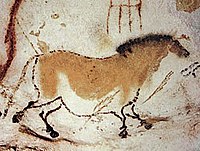
Image of a horse from the Lascaux caves.

Classificatory disputes in the 20th century have included cubist and impressionist paintings, Duchamp’s Fountain, the movies, superlative imitations of banknotes, Conceptual art, and Video games. [29]

Philosopher David Novitz has argued that disagreement about the definition of art are rarely the heart of the problem. Rather, "the passionate concerns and interests that humans vest in their social life" are "so much a part of all classificatory disputes about art" (Novitz, 1996). According to Novitz, classificatory disputes are more often disputes about our values and where we are trying to go with our society than they are about theory proper. For example, when the Daily Mail criticized Hirst's and Emin’s work by arguing "For 1,000 years art has been one of our great civilising forces. Today, pickled sheep and soiled beds threaten to make barbarians of us all" they are not advancing a definition or theory about art, but questioning the value of Hirst’s and Emin’s work.[30] In 1998, Arthur Danto, suggested a thought experiment showing that "the status of an artifact as work of art results from the ideas a culture applies to it, rather than its inherent physical or perceptible qualities. Cultural interpretation (an art theory of some kind) is therefore constitutive of an object’s arthood."[31][32]

Controversial art

Theodore Gericault's Raft of the Medusa' (c. 1820), was a social commentary on a current event, unprecedented at the time. Edouard Manet's "Le Déjeuner sur l'Herbe" (1863), was considered scandalous not because of the nude woman, but because she is seated next to men fully dressed in the clothing of the time, rather than in robes of the antique world. John Singer Sargent's "Madame Pierre Gautreau (Madam X)" (1884), caused a huge uproar over the reddish pink used to color the woman's ear lobe, considered far too suggestive and supposedly ruining the high-society model's reputation.

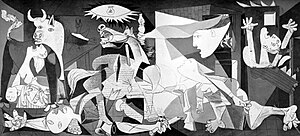
Pablo Picasso's Guernica, 1937

In the twentieth century, Pablo Picasso's Guernica (1937) used arresting cubist techniques and stark monochromatic oils, to depict the harrowing consequences of a contemporary bombing of a small, ancient Basque town. Leon Golub's Interrogation III (1981), depicts a female nude, hooded detainee strapped to a chair, her legs open to reveal her sexual organs, surrounded by two tormentors dressed in everyday clothing. Andres Serrano's Piss Christ (1989) is a photograph of a crucifix, sacred to the Christian religion and representing Christ's sacrifice and final suffering, submerged in a glass of the artist's own urine. The resulting uproar led to comments in the United States Senate about public funding of the arts.

Art, class and value

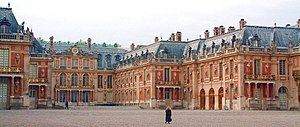
Versailles: Louis Le Vau opened up the interior court to create the expansive entrance cour d'honneur, later copied all over Europe

Art has been perceived by some as belonging to some social classes and often excluding others. In this context, art is seen as an upper-class activity associated with wealth, the ability to purchase art, and the leisure required to pursue or enjoy it. For example, the palaces of Versailles or the Hermitage in St. Petersburg with their vast collections of art, amassed by the fabulously wealthy royalty of Europe exemplify this view. Collecting such art is the preserve of the rich, or of governments and institutions.

Fine and expensive goods have been popular markers of status in many cultures, and continue to be so today. There has been a cultural push in the other direction since at least 1793, when the Louvre, which had been a private palace of the Kings of France, was opened to the public as an art museum during the French Revolution. Most modern public museums and art education programs for children in schools can be traced back to this impulse to have art available to everyone. Museums in the United States tend to be gifts from the very rich to the masses (The Metropolitan Museum of Art in New York City, for example, was created by John Taylor Johnston, a railroad executive whose personal art collection seeded the museum.) But despite all this, at least one of the important functions of art in the 21st century remains as a marker of wealth and social status.

Performance by Joseph Beuys, 1978 : Everyone an artist — On the way to the libertarian form of the social organism.

There have been attempts by artists to create art that can not be bought by the wealthy as a status object. One of the prime original motivators of much of the art of the late 1960s and 1970s was to create art that could not be bought and sold. It is "necessary to present something more than mere objects"[33] said the major post war German artist Joseph Beuys. This time period saw the rise of such things as performance art, video art, and conceptual art. The idea was that if the artwork was a performance that would leave nothing behind, or was simply an idea, it could not be bought and sold. "Democratic precepts revolving around the idea that a work of art is a commodity impelled the aesthetic innovation which germinated in the mid-1960s and was reaped throughout the 1970s. Artists broadly identified under the heading of Conceptual art... substituting performance and publishing activities for engagement with both the material and materialistic concerns of painted or sculptural form... [have] endeavored to undermine the art object qua object."[34]

In the decades since, these ideas have been somewhat lost as the art market has learned to sell limited edition DVDs of video works,[35] invitations to exclusive performance art pieces, and the objects left over from conceptual pieces. Many of these performances create works that are only understood by the elite who have been educated as to why an idea or video or piece of apparent garbage may be considered art. The marker of status becomes understanding the work instead of necessarily owning it, and the artwork remains an upper-class activity. "With the widespread use of DVD recording technology in the early 2000s, artists, and the gallery system that derives its profits from the sale of artworks, gained an important means of controlling the sale of video and computer artworks in limited editions to collectors."[36]

Forms, genres, mediums, and styles

The creative arts are often divided into more specific categories that are related to their technique, or medium, such as decorative arts, plastic arts, performing arts, or literature. Unlike scientific fields, art is one of the few subjects that is academically organized according to technique [1]. An artistic medium is the substance or material the artistic work is made from, and may also refers to the technique used. For example, paint is the media used in painting, paper is a media used in drawing.

An art form is the specific shape, or quality an artistic expression takes. The media used often influences the form. For example, the form of a sculpture must exist in space in three-dimensions, and respond to gravity. The constraints and limitations of a particular medium are thus called its formal qualities. To give another example, the formal qualities of painting are the canvas texture, color, and brush texture. The formal qualities of video games are non-linearity, interactivity and virtual presence. The form of a particular work of art is determined by both the formal qualities of the media, and the intentions of the artist.

A genre is a set of conventions and styles within a particular media. For instance, well recognized genres in film are western, horror and romantic comedy. Genres in music include death metal and trip hop. Genres in painting include still life, and pastoral landscape. A particular work of art may bend or combine genres but each genre has a recognizable group of conventions, clichés and tropes. (One note: the word genre has a second older meaning within painting; genre painting was a phrase used in the 17th to 19th century to refer specifically to paintings of scenes of everyday life and can still be used in this way.)

Detail of Leonardo da Vinci's Mona Lisa, showing the painting technique of sfumato.

An artwork, artist’s, or movement's style is the distinctive method and form that art takes. Any loose brushy, dripped or poured abstract painting is called expressionistic (with a lower case "e" and the "ic" at the end). Often these styles are linked with a particular historical period, set of ideas, and particular artistic movement. So Jackson Pollock is called an Abstract Expressionist.

Because a particular style may have a specific cultural meanings, it is important to be sensitive to differences in technique. Roy Lichtenstein's (1923-1997) paintings are not pointillist, despite his uses of dots, because they are not aligned with the original proponents of Pointillism. Lichtenstein used Ben-Day dots: they are evenly-spaced and create flat areas of color. These types of dots, used in halftone printing, were originally used in comic strips and newspapers to reproduce color. Lichtenstein thus uses the dots as a style to question the "high" art of painting with the "low" art of comics - to comment on class distinctions in culture. Lichtenstein is thus associated with the American Pop art movement (1960s). Pointillism is a technique in late Impressionism (1880s), developed especially by the artist Georges Seurat, that employs dots that are spaced in a way to create variation in color and depth in an attempt to paint images that were closer to the way we really see color. Both artists use dots, but the particular style and technique relates to the artistic movement these artists were a part of.

The Great Wave off Kanagawa by Katsushika Hokusai (Japanese, 1760–1849), colored woodcut print.

These are all ways of beginning to define a work of art, to narrow it down. "Imagine you are an art critic whose mission is to compare the meanings you find in a wide range of individual artworks. How would you proceed with your task? One way to begin is to examine the materials each artist selected in making an object, image video, or event. The decision to cast a sculpture in bronze, for instance, inevitably effects its meaning; the work becomes something different than if it had been cast in gold or plastic or chocolate, even if everything else about the artwork remained the same. Next, you might examine how the materials in each artwork have become an arrangement of shapes, colors, textures, and lines. These, in turn, are organized into various patterns and compositional structures. In your interpretation, you would comment on how salient features of the form contribute to the overall meaning of the finished artwork. [But in the end] the meaning of most artworks... is not exhausted by a discussion of materials, techniques, and form. Most interpretations also include a discussion of the ideas and feelings the artwork engenders."[37]

Characteristics

Art tends to facilitate intuitive rather than rational understanding, and is usually consciously created with this intention. Fine art intentionally serves no other purpose. As a result of this impetus, works of art are elusive, refractive to attempts at classification, because they can be appreciated in more than one way, and are often susceptible to many different interpretations. In the case of Gericault's Raft of the Medusa, special knowledge concerning the shipwreck that the painting depicts is not a prerequisite to appreciating it, but allows the appreciation of Gericault's political intentions in the piece. Even art that superficially depicts a mundane event or object, may invite reflection upon elevated themes.

Traditionally, the highest achievements of art demonstrate a high level of ability or fluency within a medium. This characteristic might be considered a point of contention, since many modern artists (most notably, conceptual artists) do not themselves create the works they conceive, or do not even create the work in a conventional, demonstrative sense. Art has a transformative capacity: confers particularly appealing or aesthetically satisfying structures or forms upon an original set of unrelated, passive constituents.

Skill and craft

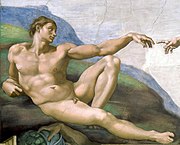
Adam. Detail from Michelangelo's fresco in the Cappella Sistina (1511)

Art can connote a sense of trained ability or mastery of a medium. Art can also simply refer to the developed and efficient use of a language to convey meaning with immediacy and or depth. Art is an act of expressing our feelings, thoughts, and observations. There is an understanding that is reached with the material as a result of handling it, which facilitates one's thought processes.

A common view is that the epithet “art”, particular in its elevated sense, requires a certain level of creative expertise by the artist, whether this be a demonstration of technical ability or an originality in stylistic approach such as in the plays of Shakespeare, or a combination of these two. Traditionally skill of execution was viewed as a quality inseparable from art and thus necessary for its success; for Leonardo da Vinci, art, neither more nor less than his other endeavors, was a manifestation of skill. Rembrandt's work, now praised for its ephemeral virtues, was most admired by his contemporaries for its virtuosity. At the turn of the 20th century, the adroit performances of John Singer Sargent were alternately admired and viewed with skepticism for their manual fluency, yet at nearly the same time the artist who would become the era's most recognized and peripatetic iconoclast, Pablo Picasso, was completing a traditional academic training at which he excelled.

A common contemporary criticism of some modern art occurs along the lines of objecting to the apparent lack of skill or ability required in the production of the artistic object. In conceptual art, Marcel Duchamp's "Fountain" is among the first examples of pieces wherein the artist used found objects ("ready-made") and exercised no traditionally recognised set of skills. Tracey Emin's My Bed, or Damien Hirst's The Physical Impossibility of Death in the Mind of Someone Living follow this example and also manipulate the mass media. Emin slept (and engaged in other activities) in her bed before placing the result in a gallery as work of art. Hirst came up with the conceptual design for the artwork but has left most of the eventual creation of many works to employed artisans. Hirst's celebrity is founded entirely on his ability to produce shocking concepts. The actual production in many conceptual and contemporary works of art is a matter of assembly of found objects. However there are many modernist and contemporary artists who continue to excel in the skills of drawing and painting and in creating hands on works of art.

Value judgment

Aboriginal hollow log tombs. National Gallery, Canberra, Australia.

Somewhat in relation to the above, the word art is also used to apply judgments of value, as in such expressions like "that meal was a work of art" (the cook is an artist), or "the art of deception," (the highly attained level of skill of the deceiver is praised). It is this use of the word as a measure of high quality and high value that gives the term its flavor of subjectivity.

Making judgments of value requires a basis for criticism. At the simplest level, a way to determine whether the impact of the object on the senses meets the criteria to be considered art, is whether it is perceived to be attractive or repulsive. Though perception is always colored by experience, and is necessarily subjective, it is commonly taken that - that which is not aesthetically satisfying in some fashion cannot be art. However, "good" art is not always or even regularly aesthetically appealing to a majority of viewers. In other words, an artist's prime motivation need not be the pursuit of the aesthetic. Also, art often depicts terrible images made for social, moral, or thought-provoking reasons. For example, Francisco Goya's painting depicting the Spanish shootings of 3rd of May 1808, is a graphic depiction of a firing squad executing several pleading civilians. Yet at the same time, the horrific imagery demonstrates Goya's keen artistic ability in composition and execution and produces fitting social and political outrage. Thus, the debate continues as to what mode of aesthetic satisfaction, if any, is required to define 'art'.

The assumption of new values or the rebellion against accepted notions of what is aesthetically superior need not occur concurrently with a complete abandonment of the pursuit of that which is aesthetically appealing. Indeed, the reverse is often true, that in the revision of what is popularly conceived of as being aesthetically appealing, allows for a re-invigoration of aesthetic sensibility, and a new appreciation for the standards of art itself. Countless schools have proposed their own ways to define quality, yet they all seem to agree in at least one point: once their aesthetic choices are accepted, the value of the work of art is determined by its capacity to transcend the limits of its chosen medium in order to strike some universal chord by the rarity of the skill of the artist or in its accurate reflection in what is termed the zeitgeist.

Communication

Art is often intended to appeal and connect with human emotion. It can arouse aesthetic or moral feelings, and can be understood as a way of communicating these feelings. Artists express something so that their audience is aroused to some extent, but they do not have to do so consciously. Art explores what is commonly termed as the human condition that is essentially what it is to be human. Effective art often brings about some new insight concerning the human condition either singly or en-mass, which is not necessarily always positive, or necessarily widens the boundaries of collective human ability. The degree of skill that the artist has, will affect their ability to trigger an emotional response and thereby provide new insights, the ability to manipulate them at will shows exemplary skill and determination.

Stanford Encyclopedia of Philosophy

The Definition of Art

First published Tue Oct 23, 2007

The definition of art is controversial in contemporary philosophy. Whether art can be defined has also been a matter of controversy. The philosophical usefulness of a definition of art has also been debated.

Contemporary definitions are of two main sorts. One distinctively modern, conventionalist, sort of definition focuses on art's institutional features, emphasizing the way art changes over time, modern works that appear to break radically with all traditional art, and the relational properties of artworks that depend on works' relations to art history, art genres, etc. The less conventionalist sort of contemporary definition makes use of a broader, more traditional concept of aesthetic properties that includes more than art-relational ones, and focuses on art's pan-cultural and trans-historical characteristics.

  • 1. Constraints on Definitions of Art
  • 2. Traditional Definitions
  • 3. Skepticism about Definitions
    • 3.1 Some descendants
  • 4. Contemporary Definitions
    • 4.1 Conventionalist Definitions: Institutional and Historical
    • 4.2 Institutional Definitions
    • 4.3 Historical Definitions
    • 4.4 Functional (mainly aesthetic) definitions
  • 5. Conclusion
  • Bibliography
  • Other Internet Resources
  • Related Entries

1. Constraints on Definitions of Art

Any definition of art has to square with the following uncontroversial facts: (i) entities (artifacts or performances) intentionally endowed by their makers with a significant degree of aesthetic interest, often surpassing that of most everyday objects, exist in virtually every known human culture; (ii) such entities, and traditions devoted to them, might exist in other possible worlds; (iii) such entities sometimes have non-aesthetic — ceremonial or religious or propagandistic — functions, and sometimes do not; (iv) traditionally, artworks are intentionally endowed by their makers with properties, usually perceptual, having a significant degree of aesthetic interest, often surpassing that of most everyday objects; (v) art, so understood, has a complicated history: new genres and art-forms develop, standards of taste evolve, understandings of aesthetic properties and aesthetic experience change; (vi) there are institutions in some but not all cultures which involve a focus on artifacts and performances having a high degree of aesthetic interest and lacking any practical, ceremonial, or religious use; (vii) such institutions sometimes classify entities apparently lacking aesthetic interest with entities having a high degree of aesthetic interest.

Evidently, some of these facts are culture-specific, and others are more universal.

There are also two more general constraints on definitions of art. First, given that accepting that something is inexplicable is generally a philosophical last resort, and granting the importance of extensional adequacy, list-like or enumerative definitions are if possible to be avoided. Enumerative definitions, lacking principles that explain why what is on the list is on the list, don't, notoriously, apply to definienda that evolve, and provide no clue to the next or general case (Tarski's definition of truth, for example, is standardly criticized as unenlightening because it rests on a list-like definition of primitive denotation). (Devitt, 2001; Davidson, 2005).) Second, given that most classes outside of mathematics are vague, and that the existence of borderline cases is characteristic of vague classes, definitions that take the class of artworks to have borderline cases are preferable to definitions that don't. (Davies 1991 and 2006, Stecker 2005)

Whether any definition of art does account for these facts and satisfy these constraints, or could account for these facts and satisfy these constraints, are key questions for the philosophy of art.

2. Traditional Definitions

Traditional definitions, at least as commonly portrayed in contemporary discussions of the definition of art, take artworks to be characterized by a single type of property. The standard candidates are representational properties, expressive properties, and formal properties. So there are representational or mimetic definitions, expressive definitions, and formalist definitions, which hold that artworks are characterized by their possession of, respectively, representational, expressive, and formal properties. It is not difficult to find fault with these simple definitions. For example, possessing representational, expressive, and formal properties cannot be sufficient conditions, since, obviously, instructional manuals are representations, but not typically artworks, human faces and gestures have expressive properties without being works of art, and both natural objects and artifacts produced for the homeliest utilitarian purposes have formal properties but are not artworks.

But the ease of these dismissals serves as a reminder of the fact that traditional definitions of art are not self-contained. Each traditional definition stands in (different) close and complicated relationships to its system's other complexly interwoven parts — epistemology, ontology, value theory, philosophy of mind, etc. For this reason, it is both difficult and somewhat misleading to extract them and consider them in isolation. Two examples of historically influential definitions of art offered by great philosophers will suffice to illustrate. First, Plato holds in the Republic and elsewhere that the arts are representational, or mimetic (sometimes translated “imitative”). Artworks are ontologically dependent on, and inferior to, ordinary physical objects, which in turn are ontologically dependent on, and inferior to, what is most real, the non-physical Forms. Grasped perceptually, artworks present only an appearance of an appearance of what is really real. Consequently, artistic experience cannot yield knowledge. Nor do the makers of artworks work from knowledge. Because artworks engage an unstable, lower part of the soul, art should be subservient to moral realities, which, along with truth, are more metaphysically fundamental and hence more humanly important than beauty. Beauty is not, for Plato, the distinctive province of the arts, and in fact his conception of beauty is extremely wide and metaphysical: there is a Form of Beauty, of which we can have non-perceptual knowledge, but it is more closely related to the erotic than to the arts. (See Janaway, and the entry on Plato on Rhetoric and Poetry.) Second, although Kant has a definition of art, he is for systematic reasons far less concerned with it than with aesthetic judgment. Kant defines art as “a kind of representation that is purposive in itself and, though without an end, nevertheless promotes the cultivation of the mental powers for sociable communication.” (Kant, Critique of Judgment, Guyer translation, section 44)). The definition, when fully unpacked, has representational, formalist and expressivist elements. Located conceptually in a much broader discussion of aesthetic judgment and teleology, the definition is one relatively small piece of a hugely ambitious philosophical structure that attempts, famously, to account for, and work out the relationships between, scientific knowledge, morality, and religious faith. (see the entry on Kant's Aesthetics and Teleology) For treatments of influential definitions of art, inseparable from the complex philosophical systems in which they occur, see, for example, the entries on 18th Century German Aesthetics, Arthur Schopenhauer, Friedrich Nietzsche, and Dewey's Aesthetics.

3. Skepticism about Definitions

Skepticism about the possibility and value of a definition of art has been an important part of the discussion in aesthetics since the 1950s on, and though its influence has subsided, uneasiness about the definitional project persists. (See section 4, below, and also Kivy, 1997, and Walton, 2007).

A common family of arguments, inspired by Wittgenstein's famous remarks about games (Wittgenstein, 1953), has it that the phenomena of art are, by their nature, too diverse to admit of the unification that a satisfactory definition strives for, or that a definition of art, were there to be such a thing, would exert a stifling influence on artistic creativity. One expression of this impulse is Weitz's Open Concept Argument: any concept is open if a case can be imagined which would call for some sort of decision on our part to extend the use of the concept to cover it, or to close the concept and invent a new one to deal with the new case; all open concepts are indefinable; and there are cases calling for a decision about whether to extend or close the concept of art. Hence art is indefinable. (Weitz, 1956) Against this it is claimed that change does not, in general, rule out the preservation of identity over time, that decisions about concept-expansion may be principled rather than capricious, and that nothing bars a definition of art from incorporating a novelty requirement.

A second sort of argument, less common today than in the heyday of a certain form of extreme Wittgensteinianism, urges that the concepts that make up the stuff of most definitions of art (expressiveness, form) are embedded in general philosophical theories which incorporate traditional metaphysics and epistemology. But since traditional metaphysics and epistemology are prime instances of language gone on conceptually confused holiday, definitions of art share in the conceptual confusions of traditional philosophy (Tilghman).

A third sort of argument, more historically inflected than the first, takes off from an influential study by the historian of philosophy Paul Kristeller, in which he argued that the modern system of the five major arts [painting, sculpture, architecture, poetry, and music] which underlies all modern aesthetics … is of comparatively recent origin and did not assume definite shape before the eighteenth century, although it had many ingredients which go back to classical, mediaeval, and Renaissance thought. Since that list of five arts is somewhat arbitrary, and since even those five do not share a single common nature, but rather are united, at best, only by several overlapping features, and since the number of art forms has increased since the eighteenth century, Kristeller's work may be taken to suggest that our concept of art differs from that of the eighteenth century. As a matter of historical fact, there simply is no stable definiendum for a definition of art to capture.

A fourth sort of argument suggests that a definition of art stating individually necessary and jointly sufficient conditions for a thing to be an artwork, is likely to be discoverable only if cognitive science makes it plausible to think that humans categorize things in terms of necessary and sufficient conditions. But, the argument continues, cognitive science actually supports the view that the structure of concepts mirrors the way humans categorize things – which is with respect to their similarity to prototypes (or exemplars), and not in terms of necessary and sufficient conditions. So the quest for a definition of art that states individually necessary and jointly sufficient conditions is misguided and not likely to succeed. (Dean, 2003) Against this it has been urged that psychological theories of concepts like the prototype theory and its relatives can provide at best an account of how people in fact classify things, but not an account of correct classifications of extra-psychological phenomena, and that, even if relevant, prototype theory and other psychological theories of concepts are at present too controversial to draw substantive philosophical morals from.

3.1 Some descendants

Philosophers influenced by the moderate Wittgensteinian strictures discussed above have offered family resemblance accounts of art, which, as they purport to be non-definitions, may be usefully considered at this point. Two species of family resemblance views will be considered: the resemblance-to-a-paradigm version, and the cluster version.

On the resemblance-to-a-paradigm version, something is, or is identifiable as, an artwork if it resembles, in the right way, certain paradigm artworks, which possess most although not necessarily all of art's typical features. (The “is identifiable” qualification is intended to make the family resemblance view something more epistemological than a definition, although it is unclear that this really avoids a commitment to constitutive claims about art's nature.) Against this view: since things do not resemble each other simpliciter, but only in at least one respect or other, the account is either far too inclusive, since everything resembles everything else in some respect or other, or, if the variety of resemblance is specified, tantamount to a definition, since resemblance in that respect will be either a necessary or sufficient condition for being an artwork. The family resemblance view raises questions, moreover, about the membership and unity of the class of paradigm artworks. If the account lacks an explanation of why some items and not others go on the list of paradigm works, it seems explanatorily deficient. But if it includes a principle that governs membership on the list, or if expertise is required to constitute the list, then the principle, or whatever properties the experts' judgments track, seem to be doing the philosophical work.

The cluster version of the family resemblance view has been defended by a number of philosophers. (Gaut 2000, Dissanayake 1990, Dutton 2006) The view typically provides a list of properties, no one of which is a necessary condition for being a work of art, but which are jointly sufficient for being a work of art, and which is such that at least one proper subset thereof is sufficient for being a work of art. Lists offered vary, but overlap considerably. Here is one: (1) possessing positive aesthetic properties; (2) being expressive of emotion; (3) being intellectually challenging; (4) being formally complex and coherent; (5) having the capacity to convey complex meanings; (6) exhibiting an individual point of view; (7) being original; (8) being an artifact or performance which is the product of a high degree of skill; (9) belonging to an established artistic form; (10) being the product of an intention to make a work of art. (Gaut, 2000) The cluster account has been criticized on several grounds. First, given its logical structure, it is in fact equivalent to a long, complicated, but finite, disjunction, which makes it difficult to see why it isn't a definition. (Davies, 2006) Second, if the list of properties is incomplete, as some cluster theorists hold, then some justification or principle would be needed for extending it. Third, the inclusion of the ninth property on the list, belonging to an established art form, seems to invite, rather than answer, the definitional question. Finally, it can be wondered whether there is a principle that unites the items on the list. Gaut construes aesthetic properties (possession of which is the first item on the list), very narrowly, but this is not essential to cluster views. Another cluster theorist, Dutton, who gives a list that overlaps very significantly with the one discussed here (it includes representational properties, expressiveness, creativity, exhibiting a high degree of skill, belonging to an established artform), remarks that aesthetic properties are omitted from his list because, he says, it is the combination of the other items on the list which, combined in the experience of the work of art, are precisely the aesthetic qualities of the work. (Dutton, 2006)

4. Contemporary Definitions

Definitions of art attempt to make sense of two different sorts of facts: art has important historically contingent cultural features, and it also, arguably, has trans-historical, trans-cultural characteristics that point in the direction of a relatively stable aesthetic core. (Theorists who regard art as an invention of eighteenth-century Europe will, of course, regard this way of putting the matter as tendentious, on the grounds that entities produced outside that culturally distinctive institution do not fall under the extension of “art” and hence are irrelevant to the art-defining project. (Shiner 2001) Whether the concept of art is precise enough to justify this much confidence about what falls under its extension claim is unclear.) Conventionalist definitions take art's cultural features to be explanatorily fundamental, and attempt to capture the phenomena —revolutionary modern art, the traditional close connection of art with the aesthetic, the possibility of autonomous art traditions, etc. — in social/historical terms. Non-conventionalist or “functionalist” definitions reverse this explanatory order, taking a concept like the aesthetic (or some allied concept like the formal, or the expressive) as basic, and aim to account for the phenomena by working that concept harder, perhaps extending it to non-perceptual properties.

4.1 Conventionalist Definitions: Institutional and Historical

Conventionalist definitions deny that art has essential connection to aesthetic properties, or to formal properties, or to expressive properties, or to any type of property taken by traditional definitions to be essential to art. Conventionalist definitions have been strongly influenced by the emergence, in the twentieth century, of artworks that seem to differ radically from all previous artworks. Avante-garde works like Marcel Duchamp's Fountain (an ordinary urinal which Duchamp exhibited at the Armory Show in Philadelphia in 1915) and other “ready-mades” – ordinary unaltered objects like snow-shovels (In Advance of the Broken Arm) and bottle-racks — conceptual works like Robert Barry's All the things I know but of which I am not at the moment thinking - 1:36 PM; June 15, 1969, and John Cage's 4''33', have seemed to many philosophers to lack or even, somehow, repudiate, the traditional properties of art: intended aesthetic interest, artifactuality, even perceivability. Conventionalist definitions have also been strongly influenced by the work of a number of historically-minded philosophers, who have documented the rise and development of modern ideas of the fine arts, the individual arts, the work of art, and the aesthetic.(Kristeller, Shiner, Carroll, Goehr, Kivy)

Conventionalist definitions come in two varieties, institutional and historical. Institutionalist conventionalism, or institutionalism, a synchronic view, typically hold that to be a work of art is to be an artifact of a kind created, by an artist, to be presented to an artworld public (Dickie, 1984). Historical conventionalism, a diachronic view, holds that artworks necessarily stand in an art-historical relation to some set of earlier artworks.

4.2 Institutional Definitions

The groundwork for institutional definitions was laid by Arthur Danto, better known to non-philosophers as the long-time influential art critic for the Nation. Danto coined the term “artworld”, by which he meant “an atmosphere of art theory.” Danto's definition has been glossed as follows: something is a work of art if and only if (i) it has a subject (ii) about which it projects some attitude or point of view (has a style) (iii) by means of rhetorical ellipsis (usually metaphorical) which ellipsis engages audience participation in filling in what is missing, and (v) where the work in question and the interpretations thereof require an art historical context. (Danto, Carroll) Clause (v) is what makes the definition institutionalist. The view has been criticized for entailing that art criticism written in a highly rhetorical style is art, lacking but requiring an independent account of what makes a context art historical, and for not applying to music.

The most prominent and influential institutionalism is that of George Dickie. Dickie's institutionalism has evolved over time. According to an early version, a work of art is an artifact upon which some person(s) acting on behalf of the artworld has conferred the status of candidate for appreciation. (Dickie, 1971) The most recent version consists of an interlocking set of five definitions: (1) An artist is a person who participates with understanding in the making of a work of art. (2) A work of art is an artifact of a kind created to be presented to an artworld public. (3) A public is a set of persons the members of which are prepared in some degree to understand an object which is presented to them. (4) The artworld is the totality of all artworld systems. (5) An artworld system is a framework for the presentation of a work of art by an artist to an artworld public. (Dickie, 1984) Both versions have been widely criticized. Philosophers have objected that art created outside any institution seems possible, although the definition rules it out, and that the artworld, like any institution, seems capable of error. It has also been urged that the definition's obvious circularity is vicious, and that, given the inter-definition of the key concepts (artwork, artworld system, artist, artworld public) it lacks any informative way of distinguishing art institutions systems from other, structurally similar, social institutions. (David Davies, 2004, p. 248-249, mentions the “commerceworld”) Early on, Dickie claimed that anyone who sees herself as a member of the artworld is a member of the artworld: if this is true, then unless there are constraints on the kinds of things the artworld can put forward as artworks or candidate artworks, any entity can be an artwork (though not all are). Finally, Matravers has helpfully distinguished strong and weak institutionalism. Strong institutionalism holds that there is some reason that is always the reason the art institution has for saying that something is a work of art. Weak institutionalism holds that, for every work of art, there is some reason or other that the institution has for saying that it is a work of art. (Matravers, 2000) Weak institutionalism, in particular, raises questions about art's unity: if nothing unifies the reasons that the artworld gives for designating entities as artworks, the unity of the class of artworks is vanishingly small.

4.3 Historical Definitions

Historical definitions hold that what characterizes artworks is standing in some specified art-historical relation to some specified earlier artworks, and disavow any commitment to a trans-historical concept of art, or the “artish.” Historical definitions come in several varieties. All of them are, or resemble, inductive definitions: they claim that certain entities belong unconditionally to the class of artworks, while others do so because they stand in the appropriate relations thereto. According to the best known version, Levinson's intentional-historical definition, an artwork is a thing that has been seriously intended for regard in any way preexisting or prior artworks are or were correctly regarded. (Levinson 1990) Historical functionalism says that an item is an artwork at time t, where t is not earlier than the time at which the item is made, if and only if it is in one of the central art forms at t and is made with the intention of fulfilling a function art has at t or it is an artifact that achieves excellence in achieving such a function. (Stecker 2005) Historical narrativism is the view that a sufficient but not necessary condition for the identification of a candidate as a work of art is the construction of a true historical narrative according to which the candidate was created by an artist in an artistic context with a recognized and live artistic motivation, and as a result of being so created, it resembles at least one acknowledged artwork. (Carroll, 1993)

The similarity of these views to institutionalism is obvious, and the criticisms offered parallel those urged against institutionalism. First, historical definitions appear to require, but lack, any informative characterization of art traditions (art functions, artistic contexts, etc.) and hence any way of informatively distinguishing them (and likewise art functions, or artistic predecessors) from non-art traditions (non-art functions, non-artistic predecessors). Correlatively, as Stephen Davies has noted, non-Western art, or alien, autonomous art of any kind appears to pose a problem for historical views: any autonomous art tradition or artworks — terrestrial, extra-terrestrial, or merely possible — causally isolated from our art tradition, is either ruled out by the definition, which seems to be a reductio, or included, which concedes the existence of a supra-historical concept of art. Historical definitions also require, but do not provide a satisfactory, informative account of the basis case – the first artworks, or ur-artworks, in the case of the intentional-historical definitions, or the first or central art-forms, in the case of historical functionalism.

As regards autonomous art traditions, it has been replied that anything we would recognize as an art tradition or an artistic practice would display aesthetic concerns, because aesthetic concerns have been central from the start, and persisted centrally for thousands of years, in the Western art tradition. Hence it is an historical, not a conceptual truth that anything we recognize as an art practice will centrally involve the aesthetic; it is just that aesthetic concerns that have always dominated our art tradition. (Levinson, 2002) The idea here is that if the reason that anything we'd take to be a Φ-tradition would have Ψ-concerns is that our Φ-tradition has focused on Ψ-concerns since its inception, then it is not essential to Φ-traditions that they have Ψ-concerns, and Φ is a purely historical concept. But this principle entails, implausibly, that every concept is purely historical. Suppose that we discovered a new civilization whose inhabitants could predict how the physical world works with great precision, on the basis of a substantial body of empirically acquired knowledge that they had accumulated over centuries. The reason we would credit them with having a scientific tradition might well be that our own scientific tradition has since its inception focused on explaining things. It does not seem to follow that science is a purely historical concept with no essential connection to explanatory aims. (Other theorists hold that it is historically necessary that art begins with the aesthetic, but deny that art's nature is to be defined in terms of its historical unfolding. (Davies, 1997)) As to the first artworks, or the central art-forms or functions, some theorists hold that an account of them can only take the form of an enumeration. Stecker takes this approach: he says that the account of what makes something a central art form at a given time is, at its core, institutional, and that the central artforms can only be listed. (Stecker, 1997, and 2005) Whether relocating the list at a different, albeit deeper, level in the definition renders the definition sufficiently perspicuous is an open question.

4.4 Functional (mainly aesthetic) definitions

Functional definitions take some function(s) or intended function(s) to be definitive of artworks. Here only aesthetic definitions, which connect art essentially with the aesthetic — aesthetic judgments, experience, or properties – will be considered. Different aesthetic definitions incorporate different views of aesthetic properties and judgments. See the entry on aesthetic judgment.

As noted above, some philosophers lean heavily on a distinction between aesthetic properties and artistic properties, taking the former to be perceptually striking qualities that can be directly perceived in works, without knowledge of their origin and purpose, and the latter to be relational properties that works possess in virtue of their relations to art history, art genres, etc. It is also, of course, possible to hold a less restrictive view of aesthetic properties, on which aesthetic properties need not be perceptual; on this broader view, it is unnecessary to deny that abstracta like mathematical entities and scientific laws possess aesthetic properties.)

Monroe Beardsley's definition holds that an artwork: “either an arrangement of conditions intended to be capable of affording an experience with marked aesthetic character or (incidentally) an arrangement belonging to a class or type of arrangements that is typically intended to have this capacity.” (Beardsley, 1982, p. 299. For more on Beardsley, see SEP, Beardsley's Aesthetics)Beardsley's conception of aesthetic experience is Deweyan: aesthetic experiences are experiences that are complete, unified, intense experiences of the way things appear to us, and are, moreover, experiences which are controlled by the things experienced. (SEP Dewey's Aesthetics). Zangwill's aesthetic definition of art says that something is a work of art if and only if someone had an insight that certain aesthetic properties would be determined by certain nonaesthetic properties, and for this reason the thing was intentionally endowed with the aesthetic properties in virtue of the nonaesthetic properties as envisaged in the insight. (Zangwill, 1995)Aesthetic properties for Zangwill are those judgments that are the subject of “verdictive aesthetic judgments” (judgements of beauty and ugliness) and “substantive aesthetic judgements”, (e.g., of daintiness, elegance, delicacy, etc. ). The latter are ways of being beautiful or ugly; aesthetic in virtue of a special close relation to verdictive judgments, which are subjectively universal. Other aesthetic definitions are easily obtained, by grafting on a different account of the aesthetic. For example, one might define aesthetic properties as those having an evaluative component, whose perception involves the perception of certain formal base properties, such as shape and color. (De Clercq, 2002).

Views which combine features of institutional and aesthetic definitions also exist. Iseminger, for example, builds a definition on an account of appreciation, on which to appreciate a thing's being F is to find experiencing its being F to be valuable in itself, and an account of aesthetic communication (which it is the function of the artworld to promote). (Iseminger, 2004) Another definition that combines features of institutional and aesthetic definitions is David Davies'. Davies adopts Nelson Goodman's account of symbolic functions that are aesthetic (a symbol functions aesthetically when it is syntactically dense, semantically dense, syntactically replete, and characterized by multiple and complex reference, which he takes to clarify the conditions under which a practice of making is a practice of artistic making. (Davies 2004; Goodman 1968)

Aesthetic definitions have been criticized for being both too narrow and too broad. They are held to be too narrow because they are unable to cover influential modern works like Duchamp's ready-mades and conceptual works like Robert Barry's All the things I know but of which I am not at the moment thinking - 1:36 PM; June 15, 1969, which appear to lack aesthetic properties. (Duchamp famously asserted that his urinal, Fountain, was selected for its lack of aesthetic features.) Aesthetic definitions are held to be too broad because beautifully designed automobiles, neatly manicured lawns, and products of commercial design are often created with the intention of being objects of aesthetic appreciation, but are not artworks. Moreover, aesthetic views have been held to have trouble making sense of bad art. (see Dickie, Art and Value, and Stephen Davies, Philosophy of Art, p. 37) Finally, more radical doubts about aesthetic definitions center on the intelligibility and usefulness of the aesthetic. Beardsley's view, for example, has been criticized by Dickie, who has also offered influential criticisms of the idea of an aesthetic attitude. (Dickie 1965, Cohen 1973, Kivy 1975)

To these criticisms several responses have been offered. First, the less restrictive conception of aesthetic properties mentioned above, on which they may be based on non-perceptual formal properties, can be deployed. On this view, conceptual works would have aesthetic features, much the same way that mathematical entities are often claimed to. (Shelley 2003, Carroll 2004) Second, a distinction may be drawn between time-sensitive properties, whose standard observation conditions include an essential reference to temporal location of the observer, and non-time-sensitive properties, which do not. Higher-order aesthetic properties like drama, humor, and irony, which account for a significant part of the appeal of Duchamp's and Cage's works, on this view, would derive from time-sensitive properties. (Zemach 1997) Third, it might be held that it is the creative act of presenting something that is in the relevant sense unfamiliar, into a new context, the artworld, which has aesthetic properties. Or, fourth, it might be held that (Zangwill's “second-order” strategy) works like ready-mades lack aesthetic functions, but are parasitic upon, because meant to be considered in the context of, works that do have aesthetic functions, and hence constitute borderline cases. Finally, perhaps heroically, it can be denied that Duchamp's Fountain is a work of art. (Beardsley1982).

As to the over-inclusiveness of aesthetic definitions, a distinction might be drawn between primary and secondary functions. Or it may be maintained that some cars, lawns, and products of industrial design are on the art/non-art borderline, and so don't constitute clear and decisive counter-examples. Or, if the claim that aesthetic theories fail to account for bad art depends on holding that some works have absolutely no aesthetic value whatsoever, as opposed to some non-zero amount, however infinitesimal, it may be wondered what justifies that assumption.

5. Conclusion

Conventionalist definitions account well for modern art, but have difficulty accounting for art's universality – especially the fact that there can be art disconnected from “our” (Western) institutions and traditions, and, conceivably, our species. Aesthetic definitions do better accounting for art's traditional, universal features, but less well, according to their critics, with revolutionary modern art; their further defense requires an account of the aesthetic which can be extended in a principled way to conceptual and other radical art. (An aesthetic definition and a conventionalist one could simply be conjoined. But that would merely raise, without answering, the difficult question of the unity or disunity of the class of artworks.) Which defect is the more serious one depends on which explananda are the more important. Arguments at this level are hard to come by, because positions are hard to motivate in ways that do not depend on prior conventionalist and functionalist sympathies. If list-like definitions are flawed because uninformative, then so are conventionalist definitions, whether institutional or historical. Of course, if the class of artworks is an arbitrary one, lacking any genuine unity, then enumerative definitions cannot be faulted for being uninformative: they do all the explaining that it is possible to do, because they capture all the unity that there is to capture. But in that case the worry articulated by one prominent aesthetician, who wrote earlier of the “bloated, unwieldy” concept of art which institutional definitions aim to capture, needs to be taken seriously, even if it turns out to be ungrounded: “It is not at all clear that these words – ‘What is art?’ – express anything like a single question, to which competing answers are given, or whether philosophers proposing answers are even engaged in the same debate…. The sheer variety of proposed definitions should give us pause. One cannot help wondering whether there is any sense in which they are attempts to … clarify the same cultural practices, or address the same issue.” (Walton, 1977, 2007)

Answers.com

n.
  1. Human effort to imitate, supplement, alter, or counteract the work of nature.
    1. The conscious production or arrangement of sounds, colors, forms, movements, or other elements in a manner that affects the sense of beauty, specifically the production of the beautiful in a graphic or plastic medium.
    2. The study of these activities.
    3. The product of these activities; human works of beauty considered as a group.
  2. High quality of conception or execution, as found in works of beauty; aesthetic value.
  3. A field or category of art, such as music, ballet, or literature.
  4. A nonscientific branch of learning; one of the liberal arts.
    1. A system of principles and methods employed in the performance of a set of activities: the art of building.
    2. A trade or craft that applies such a system of principles and methods: the art of the lexicographer.
    1. Skill that is attained by study, practice, or observation: the art of the baker; the blacksmith's art.
    2. Skill arising from the exercise of intuitive faculties: “Self-criticism is an art not many are qualified to practice” (Joyce Carol Oates).
    1. arts Artful devices, stratagems, and tricks.
    2. Artful contrivance; cunning.
  5. Printing. Illustrative material.